
The Town of Golden Sewage Treatment Plant
EOCP Facility No. 2
By Chris Cochran, AScT, Town of Golden, Director of Public Works
The Town of Golden is located within the traditional unceded territory of the Ktunaxa and Secwépemc peoples, and it is the chosen home of Métis heritage and other diverse Indigenous peoples. Golden is situated near the Alberta border in the East Kootenays; located at the confluence of the Columbia and Kicking Horse Rivers and the intersection of the Trans Canada and Highway 95 transportation corridors, Golden is also located in close proximity to six national parks.
The Town of Golden Sewage Treatment Plant occupies approximately 4.6 hectares of land and services about 4300 residents. The plant is located south of the Golden Municipal Airport, adjacent to the Columbia River on the historical site of the Golden Sawmill Company.
A Look Back: History of the Golden Sewage Treatment Plant
The Town of Golden sewage treatment plant is registered with the Environmental Operator Certification Program (EOCP) Organization as EOCP Facility Number 2 and was first classified on September 16, 1975.
According to the 1975 classification document from the files kept by EOCP, the plant consisted of preliminary treatment processes, including screening and comminution; secondary treatment using aerated lagoons; and a polishing pond with chlorine disinfection prior to discharge to the environment.
By 2005, the facility was upgraded to a Sequence Batch Reactor (SBR) secondary treatment facility including the following major components: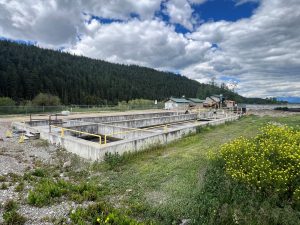
- Construction of two SBR tanks with decanters and associated blower facilities,
- A new process water supply well,
- Construction of a centrifuge dewatering building,
- Elimination of CL2 disinfection, replaced by a UV disinfection facility incorporating a Parshall flume,
- Backup diesel generator,
- Control upgrades including full SCADA monitoring/control system,
- Installation of an outfall lift pump for river discharge,
- Construction of a new river outfall.
With these upgrades completed, the facility was rated to treat a maximum daily flow rate of 4,251 m3/d of incoming effluent.
From 2016 to 2018 the following upgrades and renewals were completed:
- Complete lining of the aeration and digester lagoons,
- Replacement and upgrading of the aeration works in all lagoons,
- Installation of a third blower to support increased air delivery to lagoons.
From 2023 to 2025 the following upgrades and renewals were completed: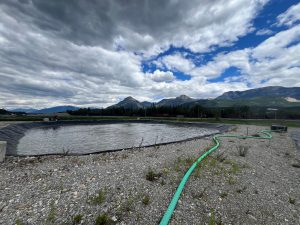
- SBR aeration equipment replacement,
- Double blank upgrades to SBR supply piping,
- Replacement of two lagoons blowers,
- Addition of second river outfall lift pump,
- SCADA computer renewals,
- Polishing pond isolation valve installation,
- Construction of dewatered sludge storage containment area.
Plant Staffing
Golden’s sewage treatment plant is currently classified as a Class 2 facility and operated by the following EOCP certified operators with the support of additional staff as required: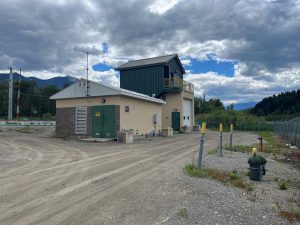
- Alan Taylor – WWT3
- Ryan Robison – WWT2
A Look Ahead: Possible Future of the Golden Sewage Treatment Plant
As constructed, and on occasion, the plant is subject to short-term hydraulic and biological overloading either in springtime due to groundwater inflow and infiltration (I&I) effects on the collection system, or during peak tourism seasons with community population influx.
For flows in excess of 4,251 m3/d, effluent is directed to available emergency stormwater detention ponds where it can be released as primary treated effluent following the peak I&I period. For biological overloading, the result is odour generation that staff must manage to the best of their ability through seasonal operational changes associated with lagoon operations.
Because of these occasional operational issues, and with a look ahead at potential growth in the community over the next 25 year plus time horizon, Golden commissioned an Upgrades Feasibility Study to explore options for increasing plant capacity. This initial study has determined that the preferred option for Golden’s plant may be to convert the SBR basins to a Moving Bed Biofilm Reactor (MBBR) secondary treatment technology sized for the future design maximum daily flow capacity of about 10,600 m3/d.
When the community does move ahead to increase plant capacity to this degree, additional component upgrades will likely include:
- Installation of a headworks facility,
- Addition of an alum dosing facility for phosphorous removal,
- Addition of dissolved air floatation (DAF) units,
- Digester expansion through aeration lagoon conversion,
- Increased dewatering capacity and improved facilities for biosolids management,
- Expansion of the UV system to meet increased flow and redundancy requirements,
- Outfall pump upsizing.
A conceptual plan illustrating the works is shown below.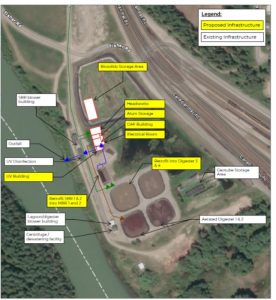
A Class D estimate for these anticipated future improvements to the sewage treatment plant is about $30 million dollars, which for a community the size of Golden is significant, ultimately requiring considerable funding support from higher levels of government to construct.
Future Expansion Concept
Source: Urban Systems STP Upgrades Feasibility Study Report Figure 4.6