Modernizing a Legacy: The Iona Island Wastewater Treatment Plant
Located just north of Vancouver International Airport (YVR), and occupying approximately 31 hectares, the Iona Island Wastewater Treatment Plant (WWTP) has served as a vital piece of the region’s wastewater infrastructure since 1963. This facility plays a critical role in managing the wastewater of over 875,000 residents in Vancouver, parts of Burnaby and Richmond, the University Endowment Lands, and UBC. It also treats more than 40% of the region’s wastewater.
With its long history and central role in protecting the health of people and ecosystems, Iona Island is now at the center of one of the largest and most ambitious infrastructure upgrades in the region’s history.
A Look Back: From Primary Treatment to Future Transformation
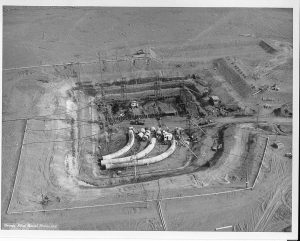 Commissioned in 1963, the Iona Island WWTP was originally constructed as a primary treatment facility, capable of removing large solids and organic materials from wastewater before it is discharged into the Strait of Georgia. Over the decades, it has been expanded and improved to accommodate a growing population. In order to treat the incoming wastewater more effectively, the plant was upgraded to include Chemically Enhanced Primary Treatment (CEPT) in 2010. This process adds coagulant and polymer to the primary treatment system which allows for greater settleability of suspended solids. Another important upgrade was the Solids Handling Facility upgrade commissioned in 2017. This facility helps to remove significant amounts of organic and inorganic materials from the sludge, prior to feeding it to the digesters. This additional step in the process has significantly improved digester performance and reduced equipment maintenance associated with heavy inorganics. On the downstream end of the digestion process, the traditional lagoon dewatering process was upgraded to a centrifuge dewatering process in 2023. The dewatered biosolids are used in land reclamation and agricultural projects.
Today, the plant is preparing for a generational leap forward. In response to federal regulations (2012) and aligned with a growing public commitment to environmental stewardship, Metro Vancouver is undertaking the Iona Island WWTP Project (Iona Project) to upgrade the plant to provide secondary treatment effluent quality.
Improving Treatment
The Iona Project will provide secondary treatment effluent quality to meet the regulatory performance (quality) requirements. A new secondary treatment facility will be constructed downstream from the existing primary plant. The secondary treatment technology, membrane bioreactor (MBR), allows the facility to be constructed in modular sections with adaptability for population growth within the region. The technology selected for secondary treatment can provide effluent quality similar to tertiary filtration. Additional modules can be added in the future.
Delivering secondary treatment in modules will allow Metro Vancouver to do additional analysis, as building is done, to determine if further treatment modules are needed. As population size increases, Metro Vancouver could install additional secondary treatment modules to enable the facility to continue to meet the secondary treatment standards in the future. New construction of the secondary treatment facility would be seismically resilient.
MBR technology produces very high-quality effluent, comparable to tertiary-filtered effluent. The project approach would build out the minimum capacity of MBR secondary treatment to meet the effluent secondary quality regulatory requirements set out by the provincial and federal regulations, while also addressing affordability and market capacity limits.
In the future, when the remaining MBR secondary treatment trains are built out, the entire secondary effluent flow will likely reach tertiary-filtered effluent quality, aligned with the Project Definition Report commitments. We will be testing performance of the MBR, and effluent quality, via pilot testing over the next two years using a pilot plant and analysis.
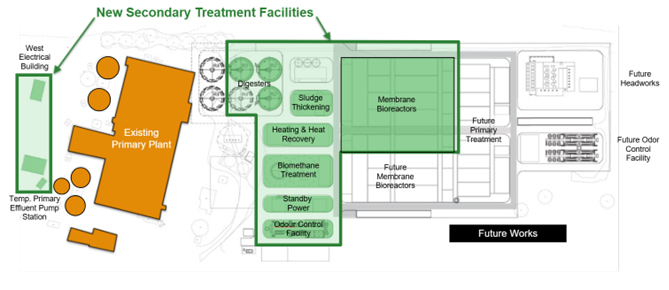 Figure 1: Site plan for the alternative approach, showing what would be delivered (in green) and components that would be future works
Environmental Benefits
The existing Iona Island WWTP outfall extends 7.2 km offshore into the Strait of Georgia via two diffusers located at depths ranging from 72 to 106 m. The implementation of secondary treatment at Iona Island WWTP will remove an additional 53 tonnes per day of total suspended solids that would otherwise be discharged to the Strait of Georgia.
The Fraser River has high naturally occurring background levels of sediment and solids, which are not considered harmful to the receiving environment. While the additional removal of total suspended solids achieved by the secondary treatment system is minor in comparison to the input from the Fraser River to the Strait of Georgia, final effluent from Iona Island WWTP does include a range of other contaminants that are known to be stressors to aquatic life.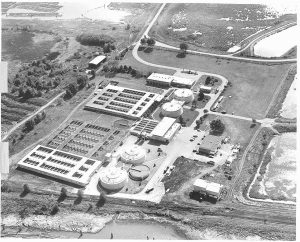
Day to Day Operations
Due to Vancouver’s combined sewer system, Iona Island WWTP treats the largest amount of flow in the region, with a maximum daily authorized rate of discharge for the plant of 1,530 million liters. Operation of the plant is carried out by dedicated certified operators who manage the process 24/7. These professionals work around the clock to monitor system performance, respond to alarms, collect samples, and deal with emergencies to maintain regulatory compliance. In addition to treating wastewater from the collections system, the Iona Island WWTP also has a domestic trucked liquid waste, and the only non-domestic trucked liquid waste receiving station for Metro Vancouver.
Like many aging facilities, the Iona Island WWTP faces a range of challenges: aging infrastructure, increasing treatment demand, stricter environmental regulations, available land for expansion, and climate risks such as sea level rise.
Metro Vancouver’s response has been proactive and forward-looking. The upgrade project addresses these challenges through:
- Installation of new treatment processes while rehabilitating existing infrastructure
- Seismic and climate-adaptive design for new infrastructure
- Community engagement with local stakeholders and xʷməθkʷəy̓əm (Musqueam Indian Band), to consider interests and opportunities in participation
By treating these challenges as opportunities for innovation, the project aims to deliver long-term benefits far beyond compliance.
A Focus on Sustainability and Community
Sustainability is a core principle in the Iona Island WWTP upgrade. The new design integrates energy recovery, with the potential to generate renewable natural gas from biosolids. The plant will also include green infrastructure elements that support water re-use, stormwater management, and ecological connectivity.
Community engagement remains a cornerstone of the project, with Metro Vancouver providing regular updates through public meetings, project websites, and open communication with community partners.
As the region continues to grow and evolve, Iona Island will remain a symbol of environmental responsibility and regional cooperation — modernizing a legacy, one stage at a time.